De anima vegetativa: working notes
Please, treat these notes just as my brainstorming ideas, like Silva (in ancient Latin meaning not only “forest”, but also “a chaotic collection of raw materials, ideas”).
I have strong sense of unity with nature. Therefore, Vegetative soul - one of my favourite creative concepts. It helps me to capture the “metamorphosis” of clay, sometimes diving into biological subconscious where humans, animals, flora and minerals collapse into a single biosynthetic entity.
In both Aristotelian philosophy and alchemy, this is the lowest yet most essential level of the soul.
In alchemical though, the Anima Vegetativa isn’t just about plants. It is the “spirit of growth” hidden within “dead” stone. Also, alchemists often described the Magnum Opus as a growing tree. They also believed in “divine water” or humidum radicale needed for matter to transform.
In psychology, Jung viewed the vegetative level as the part of psyche tied to our biological functions and instincts - the “autonomic soul”.
The concept of “Anima Vegetativa” allows me to create my own modern mythology. Talking about metamorphosis, I think not about traditional cycle (like caterpillar to butterfly), but rather about biosynthetic metamorphosis: e.g., human forms merging with plants, animals, minerals etc. In my Theatre of Matter it could perform the act of birth, rebirth, growth, bloom, decay, annihilation.
As you already know, my Theatre does not happen just in the dialogue; it happens mostly in metamorphosis. It’s more about “becoming” rather than “being”. So, when the matter of clay begins to pulse with Anima Vegetativa, the object ceases to be a sculpture and become a process.
Nature itself is a theatre of constant becoming. The forest does not just surround us, it sees, feels and remember us…
In classical works, we can find the Aristotelian Hierarchy - “The Ladder of Souls”, meaning that the soul was seen as a three-part structure:
Vegetative: nutrition and growth (shared by all life).
Sensitive: perception and movement (shared with animals).
Rational: thought (unique to humans).
I am letting this ladder to collapse and bring back again everything into one entity.
We can feel this unity of nature even in the modern “Big City”.
I also find an interesting idea to explore, that Paracelsus believed that elemental spirits - “Sylphs/Gnomes - inhabited nature, just like some of my nature inspired creatures - half-matter, half-spirits.
Did you know that Goethe searched for the “primordial plant” - a single form from which all other plants could be derived? I think I also search for it, blending human and botanical forms:)
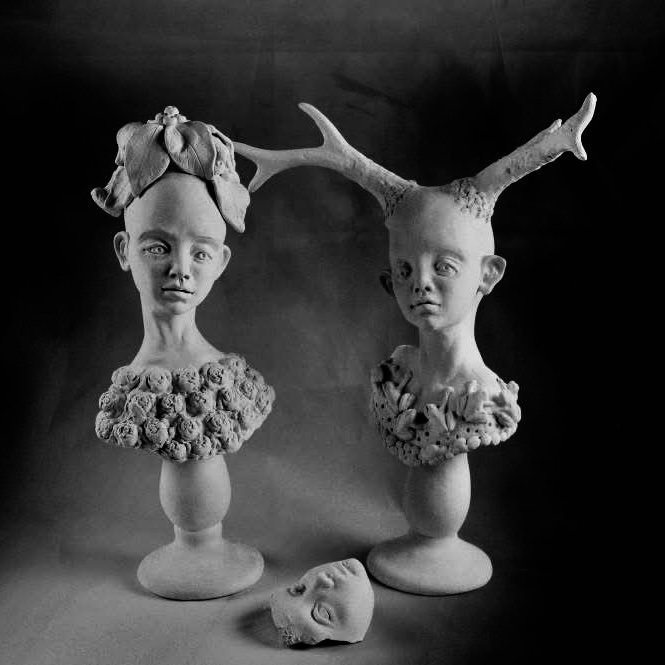
Flora & Fauna. 2018. In private collection