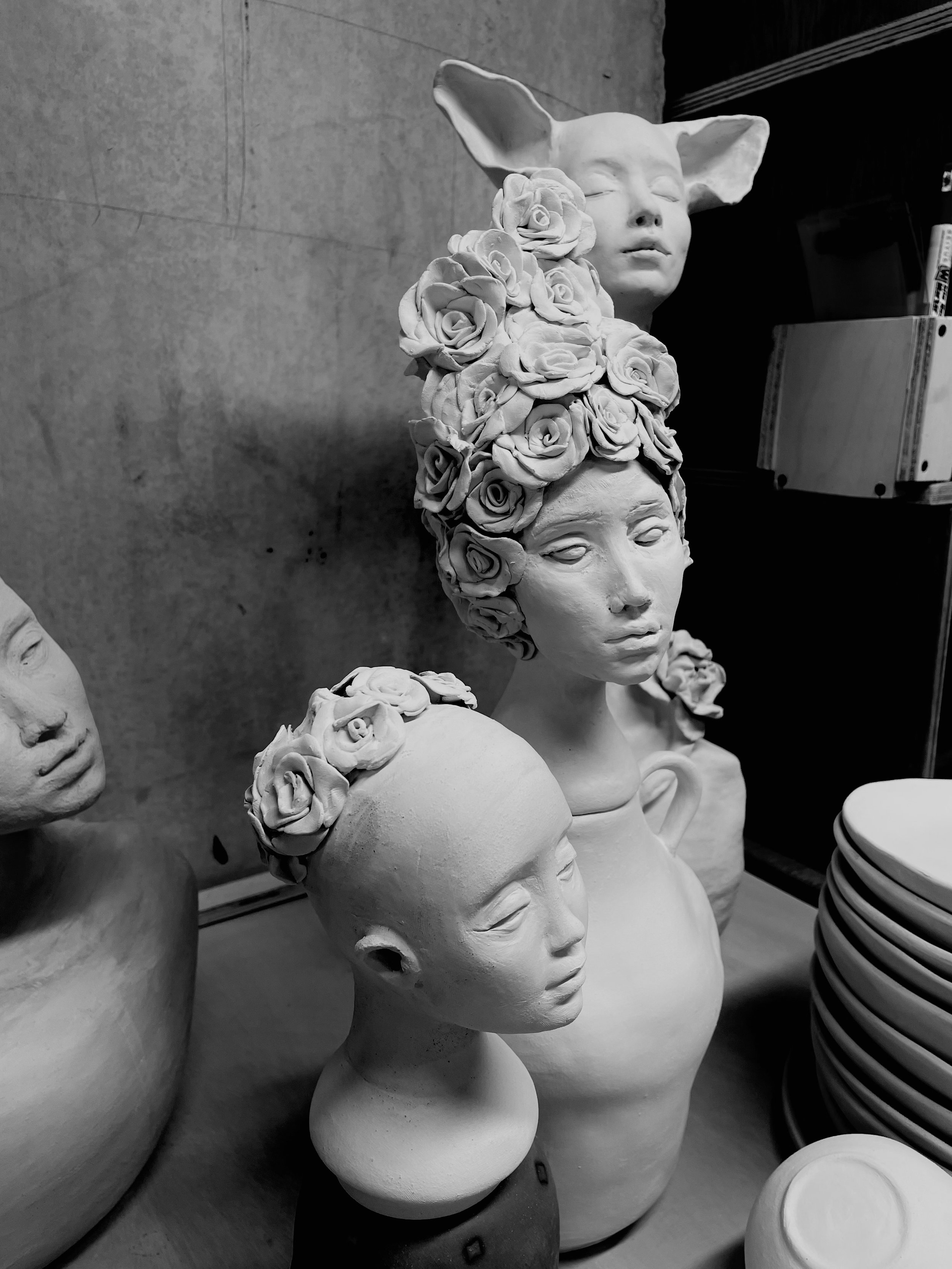
there’s something about the roses… notes from the lab
For me the rose is not a banal decoration, but rather a magic symbol.
Let’s dive into this topic a bit deeper exploring different sources.
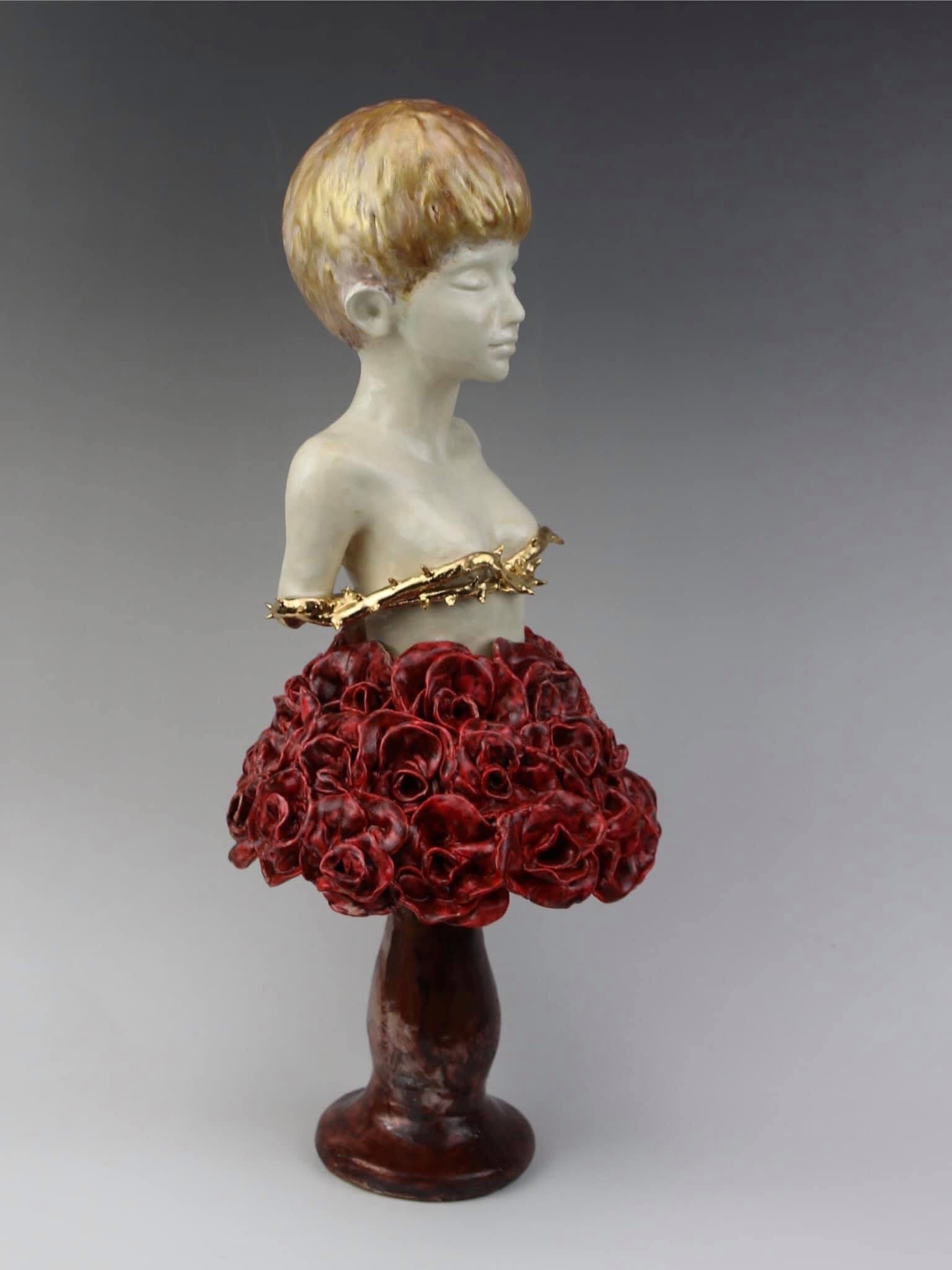
Venus, 2018
In alchemy, the rose is a symbol of soul’s transformation. It is frequently associated with the Philosopher’s Stone and the final stage of the Magnum Opus. The Red rose (Rubedo) represents solar spirit - masculine and active soul (Sulfur), and the White rose (Albedo) represents the lunar, feminine, and purified spirit (Mercury). Their “Chemical Marriage” results in the Stone.
The unfolding petals represent the “unfolding of consciousness”.
in Rosicrucianism, the rose at the center of the cross represents the human soul blooming within the “cross” of the material body.
Sub Rosa (Under the Rose): since Roman times, a rose hung above a meeting table signified that everything said was confidential. This theme of secrecy appears in medieval literature, where the rose often represent hidden or inner truth.
Dante’s “Celestial rose”: in the “Divine Comedy”, Dante envisions the highest heaven as a giant white rose. The petals are the seats of the blessed, and the “centre” is the light of the God.
Blake’s “The Sick Rose” represents the destruction of innocence by experience. The invisible worm destroying the rose from within could be treated as a symbol of materiality and decay.
In art, the Virgin Mary is often called the “Rose without Thorns”, symbolising a return to the state of grace before the “fall”. Renaissance paintings use roses to symbolise her purity.
The Vanitas Tradition: in 17th century Dutch still lives, a blooming rose is almost always accompanied by a drooping petal or a small incest - Memento Mori, reminding the viewer about the time…
The Pre-Raphaelites, for example, Dante Gabriel Rosetti used roses to symbolise overwhelming, often dangerous, romantic passion.
Antoine de Saint-Exupery - in the Little Prince, the Rose is as a specific, difficult, but beloved person. Or inner child, baby homunculus inside us? The Little Prince learns that his Rose is unique and important not because her appearance (she looks like thousands of other roses), but because of the time and care he has invested in her.
William Shakespeare mentions the rose over 70 times. For him, it is the ultimate symbol of Rubbedo - vital life force and its inevitable decay. In his Sonnets, he uses “Beauty’s Rose” to represent youth. He argues that while the physical rose withers, its distilled essence (perfume or art, poetry) can live forever. He also used the rose to signify the “Wars of Red Rose of Lancaster vs. the White Rose of York).
For Umberto Eco the Rose is a “The Sign”. In the Name of the Rose, Eco takes a postmodern, semiotic approach. He chooses the rose specifically because it is overloaded with meaning. The novel ends with the Latin hexameter: “stat rosa pristina nomine, nomina nuda tenemus” (The primal rose exists only in a name; we hold only naked names”). Eco argues that as things disappear (like the library or the character in his book), only the name remains. The Rose becomes a symbol of the “lost object, the loss of reality”. Because the rose has meant so many things (virginity, passion, secrecy, alchemy…), it eventually means nothing specific. it simply becomes a mirror for whatever the observer brings to it.
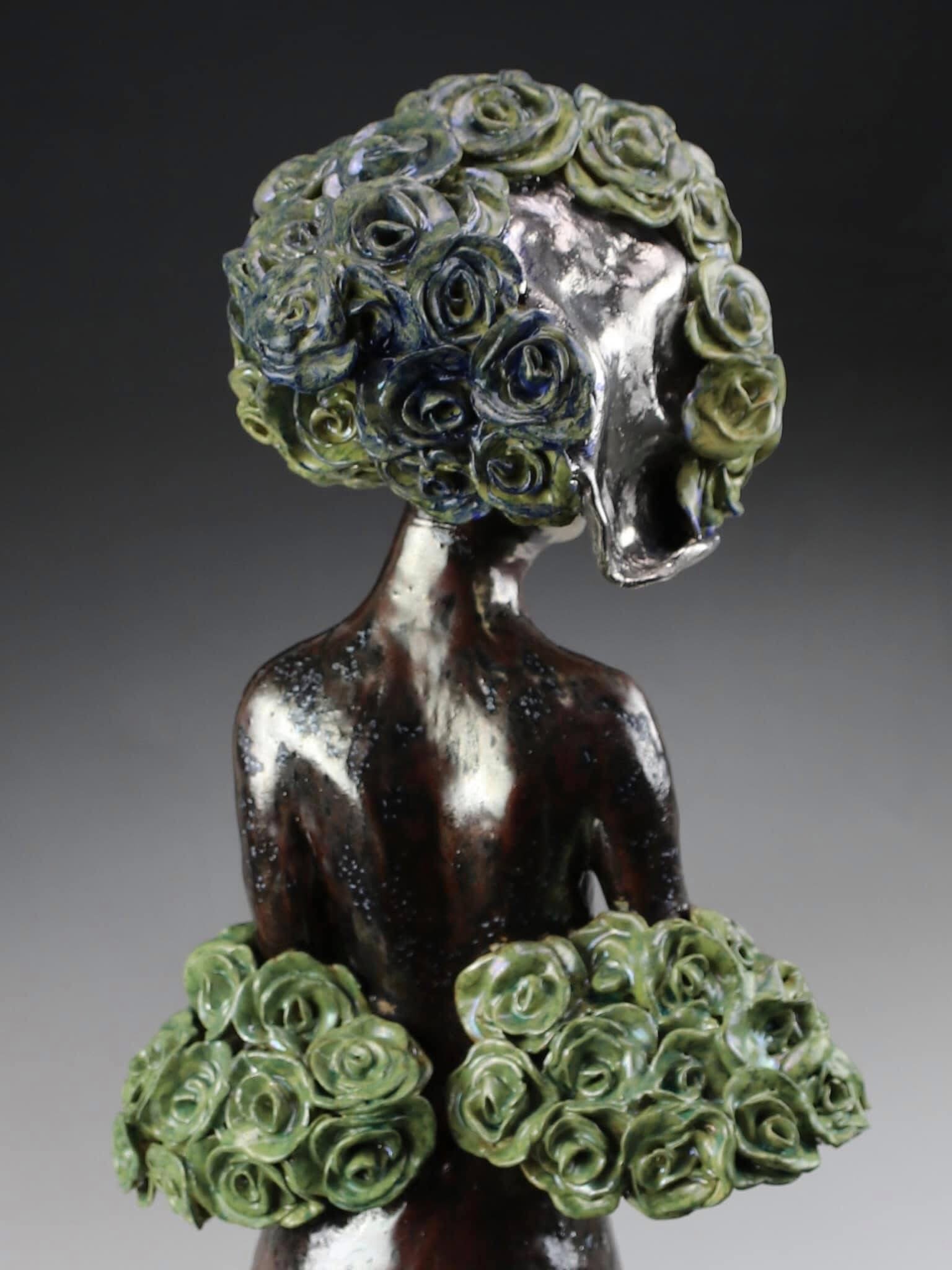
Memento Mori
For Edgar Allan Poe, the rose is like a marker of liminality - the thin, hazy line between life and death. In his Gothic world, roses often appears at the edge of the grave, representing a beauty that is already beginning to rot. The Rose as “Morbid Beauty” (The Sleeper”), in one of his most atmospheric poems, Poe describes a moonlit cemetery in June, where the lake and flowers are depicted as if they are in a state of “conscious sleep”. Poe treats the rose as a physical vessel that holds the essence of the deceased Irene. The rose “nods” to her, suggesting a weird, vegetative consciousness that blurs the line between the plant and the person. In alchemy, the “oil” or scent of the rose is its soul. Poe often uses floral scents to signal the presence of a ghost or a memory.
One more interesting story related to Poe: for decades, an anonymous figure known as “Poe Toaster” visited his grave on his birthday, leaving a half-empty bottle of cognac and three red roses.
In the Universe of my beloved David Lynch, the rose undergoes surreal transformation.
The hyper-real red rose: the mask of perfection (Blue Velvet). The very opening of “Blue Velvet” features a blazing blue sky, a pristine white picket fence, and hyper-saturated, unnaturally vivid red roses. Lynch uses the red rose as the ultimate symbol of the idealized, postcard-perfect American dream.
The “Blue Rose”: the supernatural impossible (Twin Peaks). In the Twin Peaks mythology (specifically “Fire, Walk with Me” and “The Return”), the Blue Rose is the symbol of a supernatural mystery that defies the laws of nature. FBI Director Gordon Cole establishes “Blue Rose task forces” to investigate cases involving the otherworldly entities of the Black and White Lodges. The blue rose is explicitly linked to things that are manufactured or conjured rather than born, such as tulpas (artificial entities created from thought and matter). So, a blue rose is a physical marker that says: something from the unseen world has entered the material plane.
The Artificial Rose: the illusion of reality. Lynch is obsessed with theatricality - the idea that “it is all an illusion” (like the Club Silencio scene in “Mulholland Drive”). When roses appear in Lynch’s interiors, they are frequently plastic, silk, or placed under strange, tinted stage lights. The rose ceases to be a living plant and becomes a prop in a psychological theatre. Environment becomes a projection of characters own subconscious, traumas, desires. So, in a lynchian context, if a rose appears, it isn’t a symbol of love and romance, it is a warning signal that the beautiful surface is about to rote, or it is a cosmical marker indicating the presence of a tulpa, a ghost, or an altered state of consciousness.
Speaking about the fairy tales, for Hans Christian Andersen and the Brothers Grimm, the rose is often a bridge between the physical world and the spiritual or “correct” path. Roses can act there as a protective shield or a memory trigger for the soul.
Andersen used the rose as a deeply religious and emotional symbol, like a piece of ‘“heavenly matter” that survived the fall from the Eden. In the Snow Queen, Gerda and Kai have a rooftop rose garden that connects their homes. When Kai is infected by the troll-mirror splinter (a mechanical, cold distortion), he kicks the roses and sees them “as ugly as worm-eaten”. Later, a sorceress makes Gerda forget Kai and hides all the roses underground so Gerda won’t remember him. But rose on the sorceress’s hat triggers Gerda’s memory - her tears fall on the ground, “resurrecting” the rose bush. In another story of H.K.A. “The Elf of the Rose”, a tiny elf lives in a rose. He witness a murder and helps the victim’s lover “preserve” memory by leading her to the body.
The Grimms’ roses are more structural and protective. They often represent the physical barrier between the “domestic” world and the “wild” world. In the “Sleeping Beauty”, the princess is named Dornroschen (Little Briar Rose). When she falls into her 100 year sleep, a massive hedge of thorny briars grow around the castle. The thorns are lethal to those who try to force their way in too early. Only when the time is “ripe” (the cycle is complete) the thorns turn into large, beautiful flowers. Snow White’s story features two rose trees - white and red, that represent two sisters. Snow White is quiet and domestic (the Albedo/white rose), while Rose Red is active and loves the outdoors (the Rubedo/red rose). Their unity - living together in harmony with their mother and eventually marrying two brothers - represent a “perfected” human state.
The Rose as a life force (The Beast’s Rose). Though the most famous version is the French “Beauty and the Beast”, the motif of the “Rose as a Timer” appears across many folk traditions. The rose is physical object that tracks a spiritual deadline. As each petal falls, the “materiality” of the Beast’s curse grows heavier.
In history, the symbol of rose mostly means the extreme secrecy and “hidden knowledge”.
The Wars of Roses (1455-1487). The most famous “war of symbols” in history. The house of Lancaster used the Red Rose, while the House of York used the White Rose. When the wars ended, Henry VII created the Tudor Rose - a white rose superimposed on a red one. This was forced “unification of opposites”. Interestingly, the idea that everyone walked around wearing rose pins during the war is largely a later literary invention (popularised by Shakespeare). In reality, the rose was one of many symbols, but history “distilled” the conflict down to the rose , probably because of its powerful symbolic weight.
The most famous “rose” society is the Order of the Rosy Cross (Rosicrucians), founded in the early 17th century. Their symbol is rose blooming at the centre of a cross. To them, the cross represents physical body and the suffering of materiality, while the rose represented the expanding consciousness or the soul. They were deeply alchemical, and believed in the “regeneration” - the idea that a new man, a spiritual homunculus could be grown from the shell of the old one through secret knowledge. They were often called “The Invisibles” because they claimed to operate in total secrecy, only revealing themselves to those “pure” enough to see the rose.
The phrase Sub Rosa (under the rose) is a historical staple for secret meetings, government intelligence and confidential legalities. It has the Roman origins. Romans would hang a wild rose above the doors of meeting rooms or banquet tables. Anything said “under the rose” was strictly confidential.
In the Middle Ages, roses were often carved into Catholic confessionals as a reminder that the conversation was sacred and secret.
In the 16th century, King Henry VIII has a massive Tudor Rose carved into the ceiling of his private chambers were secret state decisions were made.
In mythology, the rose is almost always a product of transformation - usually born from a mixture of divine blood and earthly sorrow.
In the Greco-Roman tradition, the rose is usually a creation born from emotion. The most famous myth tells of Aphrodite (Venus) rushing to her dying lover Adonis. As she run through thorn bushes, her blood stained the white roses red. In other versions, the red rose grew there the blood of Adonis mixed with Aphrodite’s tears. Another myth tells us, that the goddess Flora (Chloris) once found a dead nymph and, out of grief, asked the other gods to transform the body into a flower. Apollo gave it life, Bacchus gave it fragrance, and Aphrodite gave it beauty. The rose is thus reconstructed soul, a floral homunculus made from fragments of divine. One more legend says the rose originally had no thorns. One day, Eros (Cupid), was stung by a bee while smelling a rose. In a fit of anger, he shot a quiver of arrows into the rose bush. The arrow remained, becoming the thorns.
In Persian mythology, we find even a more mystical interpretation. In the Gol-o-Bolbol (Rose and Nightingale) the Nightingale is so in love with the Rose that it presses its breast against the thorns to be closer to the flower’s heart, and its blood stains its petals red. And the bird’s song becomes more beautiful the more it suffers for the rose.
In Egyptian mythology, the rose is the flower of Isis, the goddess of magic and motherhood. It was considered a symbol of regeneration and the afterlife. Rose garlands have been found in 2nd century Egyptian tombs, maybe with the intention to help the deceased “bloom” again in the next world - who knows… Cleopatra famously used rose petals to reinforce her status as a living goddess. When she met Mark Antony, she filled her room knee-deep in rose petals so that he wood forever associate the scent of roses with her divine presence.
In Hindu mythology, the god Vishnu and the god Brahma once argued over which flower was the most beautiful. Vishnu chose the rose, while Brahma chose the lotus. When Brahma saw Vishnu’s rose, he conceded. Also, according to legend, the goddess Lakshmi was created from 108 large and 1,008 small rose petals.
In Nordic countries, while not as prominent as in Mediterranean, the rose is sometimes associated with Frigg (the goddess of motherhood/domesticity) and the goddess Freya. In some modern interpretations, the rose is a plant of “protection and sex” used to bridge the gap between the wild world and the home.
In Baltic culture (I am from Lithuania), the rose steps away from classical Western romance and takes on a deeply cosmic, primal role. It becomes a symbol of a celestial fire, a geometric key in folk art, and an emblem of ultimate physical sacrifice. The rose as living piece of the sun, as “Botanical Fire”. In Baltic mythology, the rose is considered the literal botanical manifestation of Saule, the powerful Sun goddess. To the ancient Balts, blazing fire was linked to red blossoms. Riddles and folk songs frequently describe the rising and setting sun as a celestial rose bush, a fiery garden, or a glowing rose wreath moving across the sky. In traditional Lithuanian winter solstice and Christmas songs, the rebirth of the sun goddess is celebrated as the blooming of a mystical rose. The rose represent the exact point where the cosmic fire cools enough to take on material, floral form. The Geometric Rose (Rozele) - the Center of the World: in Baltic textile weaving, woodcarving, and traditional sashes, the rose (rozele or roziuke) is transformed into a highly specific geometric symbol. But instead of rounded, organic petals, the Baltic rose is stylized as a diamond with extensions. It sits at the exact point where parallel lines cross and ramify. In the Cosmic Matrix it acts as a transitional sign between the organic plants world and the geometric mathematics of the universe (Saules Zyme or the Sun Sign). It represents a centrifugal center - the point from which life radiates outward. So, the geometric Rozele is the axis of the Universe at its very center.
In Latvian history and lore, the most famous rose is a person - Maija, known as the Rose of Turaida (1601-1620). Found as an orphan baby amidst the ruins of battlefield, Maija grew into a famously beautiful yang woman. Cornered in a sacred cave by a rogue soldier intent on capturing he, she chose death over the destruction of her honor. She tricked the soldier by handing him silk scarf, claiming it was an alchemical, magical talisman that made the wearer entirely immune to blades. She challenged him to test it on her own neck. He struck her, and she died instantly. Her lover, a castle gardener, buried her and planted rose bushes around her grave. To this day in Latvia, newlyweds visit her grave to leave flowers.
In Japan the rose also has a unique meaning, though not so important as a cherry blossom (Sakura) or the Chrysanthemum. Still, it represents a refined beauty, the “impossible” and a modern language of secret emotions.
Traditional Roots: the Wild Rose (Nobara). Long before the Western roses arrived, Japan had its own indigenous wild roses. Roses appear in the Manyoshu, the oldest collection of Japanese poetry, 8th century. They were often associated with Thorns (ibara), and the bittersweet pain of longing. Hanakotaba (the Language of Flowers): in Japan’s specific floral code, the rose generally symbolises beauty and elegance, but specific colours have distinct meanings, like red - pasion/love like in the West; white - devotion or “spiritual love”; pink - happiness, gratitude and “grace”; yellow - while often “jealousy’ in West, in Japan it can signify “self-sacrifice” or “peace”.
The “Blue Rose - alchemy vs. genetic science. Creation of the Blue rose - impossible, because roses lack the delphinidin pigment. In 2004, Suntory, a Japanese company successfully used genetic engineering to create the world’s first blue rose. Because of this, the Japanese meaning of blue rose shifted from “attaining the unattainable” to “dreams come true” or “miracle”.
Roses were highly valued by the ruling class in the Edo period. In the “Ichinoma”, the highest-ranking room of Kyoto’s Nijo Castle, there are stunning 17th century paintings of red roses. While the Sakura represented the transience of a warrior’s life (falling at the peak of the beauty), the rose represented resilience. A wild rose can grow in harsh conditions and protect itself with thorns, mirroring the “inner strength” a samurai was expected to possess.
The old masters - especially those from the Italian Renaissance and the Dutch Golden Age - used symbol of rose as precise theological and scientific instrument, a living system of geometry and biology. Leonardo da Vinci didn’t care for the rose as a romantic so much as a mathematical and biological marvel. Leonardo made extensive sketches of roses (such as the Guelder rose). He was obsessed with phyllotaxy - the spiral arrangement of leaves and petals. For him it was a demonstration of proportional growth, similar to how he mapped the human body in the Vitruvian Man. His most famous floral work was for the lost painting Leda and the Swan. He drew plants with the same “anatomical” intensity he used for human muscles. He saw no difference between the “mechanism” of a rose and human arm.
Leonardo was an artist - scientist, while Sandro Botticelli was the myth-maker. In his iconic painting “The Birth of Venus”, roses are shown falling from the sky. According to myth, the rose was created at the exact moment Venus was born. For Botticelli, rose represented Dual Love - the light pink petals symbolized “divine/intellectual love” while the thorns represented “earthly/physical passion”. In his religious work “Hortus Conclusus”, he often placed Virgin Mary in a “Rose Bower” or “Enclosed Garden”. This was a symbol of her purity - “a rose without thorns”.
The Duchess Masters: The Vanitas Rose. In the 1600s, artists like Jan Brueghel the Elder (nicknamed “Flower Brueghel”) and Jan Davidsz. de Heem used roses to talk about decay. The Memento Mori: they would paint hyper-realistic roses, but if you look closely, there is often a wilting petal, a drop of dew, or a small insect eating the leaf. The Dutch masters often used a “glass vase” to show the stems of the roses underwater - distorted and magnified, just like our cortical homunculus distorts our bodies…
In contemporary pop culture, the rose undergoes essential transformation. It is stripped of its ancient, delicate nobility and re-enginered into something more aggressive, commercial and subversive. Pop culture treats the rose as ready-made relic - a familiar shape that artists intentionally break, electrify or fuse with metal to create a new kind of “urban alchemy”. Pop art removed the rose from nature and placed it onto the factory conveyor belt, turning it into symbol of commercialism and emotional replication. Andy’s Warhol’s screen-printed flowers took organic shapes and flattened them into neon, repetitive graphics. By duplicating the image over and over in harsh acrylics, the rose lost its “sacred” singularitry and become a consumer product - much like a soup can. But still, if beauty can be infinitely manufactured, does it lose its soul?
Tom Wesselmann often juxtaposed hyper-clean, stylised roses alongside mundane domestic objects or cold, hard-edged Americana. It stripped the flower of its historical poetry, making it a bold, graphic prop in a highly staged, sterile environment. Why rose?..
In rock music, the rose is almost always paired with its shadow side - the thorn, the skull or the blade - to symbolize the violent collision of passion and destruction. Guns N’Roses’ iconic logo - two red roses intertwined around two chrome pistols - modern unification of opposites. The symbol of organic vulnerability fuses with the symbol of industrial violence.
The skeleton and the rose: designed by iconic poster artists Alton Kelley and Stanley Mouse, the “Scull and Roses” motif became a counterculture emblem. Crowning a cold dead sceleton with a wreath of vibrant red roses is classic Memento Mori.
Depeche Mode’s Violator: the cover of the seminal 1990 alternative album features a single, starkly lit red rose against the void of deep black, captured by Anton Corbijn. It became an emblem of dark, synthetic melancholy - the biological rose trapped inside an electronic, industrial landscape.
In modern pop stardom and high fashion, the rose is used as a theatrical mask or a statement on the fluidity of gender and identity.
Nick Cave and the Dark Rose: in alternative rock and gothic pop - the rose as lyrical weapon (like in the album “Murder Ballads” or the song “Where the wild roses grow”). Here, the rose represents beauty that is dangerous, tragic, and intimately tied to death.
Alexander’s MsQueen’s savage beauty: this fashion designer constructed dresses made of a real roses that would wilt, drop petals, and literally fall apart down runway. A live performance of the weight of materiality - the garment itself dying in front of the audience, transforming from a couture masterpiece into a pile of organic debris.
In David Bowie’s world the symbols rarely were static. Rose is not an exception. Bowie approached symbols much like an alchemist or a surrealist - he would borrow an image from classic history, occult lore, or literature, and then twist it to fit his current theatrical canvas. When it comes to the rose, Bowie’s relationship with it manifests in a few ways that tie straight back into the themes of alchemy, transformation and the uncanny. The Twin Peaks, “Fire Walk With Me connection” - Agent Phillip Jeffries and the Blue Rose. Bowie’s character is a fractured traveler who slips through a tear in time and space, having witnessed the terrifying entities of the Lodge firsthand. In this context, Bowie literally became a primary actor within the Blue Rose Task Force.
The Gnostic and Alchemical Traces: “Station to Station”. Bowie was obsessed with Western esoterism, the Kabbalah and Gnosticism - particularly during his mid 1970s “The White Duke” era. The Sclera of Crowley and Rosicrucianism: on the back cover of Station to Station album, Bowie is seen drawing the Kabbalistic Tree of Life. In Rosicrucian and Gnostic thought the Rosy Cross (the rose blooming at the centre of the cross) represents the inner spiritual spark overcoming the heavy matrix of physical matter. For Bowie, who was rebuilding his own sanity and identity every few years, this alchemical “blooming from the centre of suffering” was a deeply personal metaphor for his own self creation.
“Pretty Pink Rose” (1990). On a more literal pop-culture note, Bowie wrote and recorded a track called “Pretty Pink Rose” (released as a duet with guitarist Adrian Belew). Typical of Bowie’s “cut-up” lyric style, the track blends historic and political imaginery (making reference to Thomas Paine in Paris and political subversion) with a driving, gritty beat. Here, the pretty pink rose is treated subversively - a traditional, delicate symbol of romantic compliance that the narrator actively resists or deconstructs. It’s Bowie’s taking a standard floral cliche and wrapping it in jagged, alternative rock textures.
In general, the rose for David Bowie was an emblem of the anomalous and metamorphic. He understood, that to make a symbol powerful, he has to place it in an environment where it doesn’t belong - letting a drop of vivid crimson or neon blue catch the light inside an dark, industrial void.